

“THE ORCHARD OCD CONVERSATIONS”
We are very excited to share with you that the next episode of the Orchard OCD conversations webinar series. This episode features Marjan Biria.
Marjan will be talking about her ground-breaking MRS work (which you can read about here https://www.nature.com/articles/s41467-023-38695-z#Sec2).
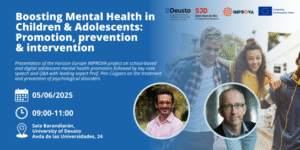
We are pleased to invite you to a special event “Boosting Mental in Children and Adolescents: Promotion, Prevention and Intervention” organised within the framework of the IMPROVA project and hosted by the University of Deusto. The event will feature a keynote address by the distinguished Professor Pim Cuijpers—a leading global expert in psychological interventions and youth mental health. It will also include the presentation of the IMPROVA programme, a digital intervention to boost children and adolescent mental health implemented with more than 5000 students in four EU countries.
This is a unique opportunity for scholars, practitioners, and stakeholders across disciplines to engage with cutting-edge knowledge and practical approaches for enhancing the mental health and well-being of young people.
We encourage all members of the academic community—from psychology and education to public health and social work—to attend and contribute to this critical conversation. It will take place on June 5 2025, 09:00 – 11:00 at University of Deusto & Online.
Registration is required: https://docs.google.com/forms/d/e/1FAIpQLSf7STmxAiC0i4Xv-TVnPX7gRnJdJVze-bIO2a-isflpT-92IQ/viewform?usp=header
Prof. Pim Cuijpers: Professor Emeritus of Clinical Psychology and Director of the WHO Collaborating Centre for Research and Dissemination of Psychological Interventions at Vrije Universiteit Amsterdam, Prof. Cuijpers is a global leader in research on mental health prevention and intervention, with over 1,300 publications. He is Editor-in-Chief of the Journal of Consulting and Clinical Psychology and recipient of the 2024 APA Award for Distinguished Professional Contributions to Applied Research.
Rodrigo Lima, Ph.D., is a researcher at Parc Sanitari Sant Joan de Déu in Spain and a member of the Centre for Biomedical Network Research on Mental Health (CIBERSAM). He serves as the scientific coordinator of IMPROVA and is the Principal investigator of ePro-Schools, an EU funded project by the ERA4Health Programme (GA 101095426), which also aims to promote health and wellbeing among youth through an eHealth intervention program.
More information:
https://www.improva-project.eu/event-boosting-mental-health-in-children-adolescents-promotion-prevention-intervention/
We hope that you can attend.
We are very pleased to announce that the next episode of our webinar, ‘The OCD Conversations’, will be with our very own Tricia Seow. Tricia will be discussing doubt in OCD and her new research project, which is being supported by Orchard OCD.
The episode will be broadcasted live on Tuesday, 27th of May 2025, at 5pm BST, and will later be posted on Orchard’s YouTube channel.
Please join us if you can!
Early brain development in children born to depressed mothers in high and low-income settings
Postdoctoral Fellow: research project starting April 2023 Department of Psychiatry & Mental Health; Faculty of Health Sciences
Applications are now invited for a postdoctoral research project in developmental neuroscience, which will be embedded in a larger five-year project (2022-2027) that is funded by an NIMH R01 research grant.
Click here for more information
Cape Town: Almost a third of the South African population will present with a mental disorder such as depression, substance abuse, anxiety, bipolar disorder and schizophrenia during their lifetime.

Stellenbosch University Professor Christine Lochner.
Yesterday, marked World Mental Health Day. It gives us the opportunity to reflect upon mental health, not only on the mentioned day but also during the remainder of the month. For 2021, the theme is ‘Mental Health in an Unequal World’. This theme is particularly relevant for a country like South Africa that has also been described as one of the most ‘unequal’ societies in the world. In this article, I would like to unravel aspects of this complex phenomenon and how it plays out within our local mental health context.
How wonderful would life be if we were all born equal? Alas, inequality starts very early on. From birth, the human condition seems to be unequal! Some of us are born with genes that make us thrive and be resilient. Others are less fortunate. And beyond the womb, we are cast into an unequal world. Despite apartheid ending more than 20 years ago, many South Africans are born into poverty and other adversities. Material inequalities continue to grow: the wealthy becoming wealthier, and the number of poor people rising. How does this impact mental health?
Arguably, mental illness and poverty are two sides of the same coin: on the one side, there are many people living in poverty, possibly unemployed and lacking adequate housing and basic amenities, who are at increased risk of mental illness. On the other side, people with a mental illness are more likely to drift into or remain in poverty because of reduced productivity or unemployment and increased health expenditures. A vicious cycle, indeed. The interplay between these inequalities within South Africa is complex and has detrimental consequences for mental health and appropriate healthcare.
Mental illness is rife across the globe, as in our country. Moreover, there is evidence that more than 40% of people living with HIV in the country have a diagnosable mental illness.
Women and children may also be at increased risk: one study showed that a third of mothers living in low-income and informal settlements in Cape Town suffer from postnatal depression, whereas almost half of pregnant women from KwaZulu-Natal present with depression. Estimates suggest that in the Western Cape, one out of six children have a diagnosable mental health condition. These rates are alarming and higher than the prevalence of these conditions in developed countries.
There is consensus that there is no health without mental health. Indeed, mental, physical, and social health are essential parts of life, closely interdependent, with mental health being crucial to the overall well-being of individuals and society. However, it seems that South Africa, like many other countries across the globe, does not consider mental health a priority.
This is exemplified by the fact that fewer than 1 out of 10 individuals with a mental illness will receive the care that they need, despite the fact that many mental health problems can be treated at clinics and hospitals.
Evidence suggests that between 75% and 95% of people with mental disorders in low-and middle-income countries like South Africa are unable to access mental health services. And those that do have access are not necessarily receiving sufficient or appropriate care.
The recent Life Esidimeni tragedy, resulting in the death of 144 mental health patients and exposure of 1418 others to trauma and poor health outcomes in the Gauteng Province, has shocked the nation, casting the spotlight on mental healthcare and revealing some of the systemic inadequacies and inequalities in our society.

A recent march to remember the Life Esidimeni tragedy.
Even though neuropsychiatric disorders are ranked third in their contribution to the burden of disease in South Africa, after HIV/Aids and other infectious diseases, mental health remains the neglected child of the local healthcare system.
Although steps have been taken towards strengthening mental health care in the last 20 years, including reforming the Mental Health Care Act 2002 and developing a National Mental Health Policy Framework and Strategic Plan 2013-2020, the Department of Health spends only 5% of the total health budget on mental health services, leaving mental health under-funded and under-resourced. Such lack of investment in mental health, disproportionate to the overall health budget, contributes to the mental health treatment gap.
Furthermore, mental healthcare services are centralised in large urban hospitals, while rural communities are neglected. There also seems to be enormous inequality between provinces in the distribution of mental healthcare services and resources. However, the truth is that there is a dire shortage of trained mental healthcare professionals everywhere in the country and facilities in all provinces are stretched to the limit due to the current demand.
In 2020, the Covid-19 pandemic hit an already unequal world, impacting us all, but perhaps more so the world’s most vulnerable through loss of lives, health, jobs, incomes, and education. Mental health has also been affected, with many people facing increased levels of depression, anxiety, insomnia, and alcohol and substance use, thus, increasing the demand for the already limited mental health services. Covid-19 has also interrupted access to essential mental health services.
In response, the World Health Organization has issued guidelines to countries on how to maintain essential services, including mental health services. It is their recommendation that countries allocate resources to mental health as an integral component of their response and recovery plans.
Where mental health is concerned, we continue to live in an unequal world. Nevertheless, we all have a role to play, indirectly or directly, to address these disparities. The month of October presents another opportunity to reflect on the issues that perpetuate mental health inequality and to educate our people and those in power about the value of mental health and highlight the importance of accessible, appropriate, and sufficient care for all.
Such efforts should not be limited to the month of October, however. In November, for example, it is election time in South Africa, and we all have the right to vote. This is an ideal opportunity to elect people that prioritise mental health and mental healthcare and who can take a stand against stigma and discrimination, to ultimately address the inequalities that hold back people with mental illness and their families.
*Professor Lochner is affiliated with the SAMRC Unit on Risk and Resilience in Mental Disorders in the Department of Psychiatry at Stellenbosch University.
 The COVID-19 pandemic is a crisis for us all. It is unknown territory and the future is uncertain. This creates anxiety and has the potential to exacerbate mental disorders in those living with them. We all have to adapt to the change that this virus has brought into our lives.
During periods of prolonged stress and uncertainty, changes occur in the brain. Some people will become more susceptible to stress the next time it occurs, whereas others will become more resilient. In a crisis like this one, even the more resilient people may become anxious. It is therefore important to find ways to maximize your resilience and to become aware of and manage your stress levels.
The COVID-19 pandemic can be an opportunity for growth. We cannot control what will happen tomorrow. Worry over tomorrow will only deplete our energy and frustrate us. One can either stay in a fear spiral: panic, buy everything one can, forward all messages without validating the source, complain frequently, spread negative energy, or move into a growth spiral: being comfortable with giving up what you cannot control, being thankful for what you have, stop consuming food or news compulsively, seeing this as a special time for self-reflection. Here are a few things you can do to boost your resilience and to grow as a person:
Routine, routine: Change your pace, but keep your routine. Keeping with routine is helpful in a time that is unknown and uncertain to all. Get up in the morning at the same time you would normally. Get dressed (if you look sloppy, you will feel sloppy). Structure your day. Make your bed and keep your home neat: if your environment is clean and ordered, you will feel more in control. If you work from home, keep to your working hours, but be mindful to create clear distinctions between work and non-work activities.
Take control to increase a sense of safety: Wash/sanitize your hands frequently and do not touch your face. Cover your mouth and nose with a tissue when sneezing/coughing or cough/sneeze into your elbow. Wash your hands after coughing or sneezing. Wear a mask to protect others and yourself from droplets. Stay at home when you are sick. Regularly clean and disinfect objects or surfaces in your house. Good preparation will make you feel more in control – if you have to buy supplies, make a list and keep your physical distance when shopping.
Practise mindfulness and self-care: Sit, walk, eat and breathe mindfully. The lockdown period is an opportunity to discard bad habits and to cultivate new healthier ones, because we have more time to think, to evaluate and to plan. Limit unhealthy coping strategies such as alcohol and drug use as this may exacerbate anxiety. Now could also be a golden opportunity to clean out cupboards, organise old photos and doing things you always wished that you had time for. Your home environment has a tangible effect on your well-being. To build mental agility, reading, walking, gardening and trying new things such as online courses could be helpful. During this time, frame your goals positively and realistically. Be reasonable and flexible and follow through.
Sleep and relaxation: Deep breathing exercises and other types of relaxation techniques can assist in taking the edge off of anxiety. Are you getting enough good quality sleep? Be mindful of over-stimulation by electronic devices, TV, cell-phones, computers, etc. Engage in mood-boosting activities such as listening to music, practising hobbies and board-games with family or friends (this can be done remotely as well).
Healthy eating: During the lockdown period it is important to make good food choices. Use this time to prepare your meals from scratch. This is an ideal time to engage your children in the preparing and cooking of meals, to teach them how to lay a table and to make the most of mealtimes together as a family. Remember to drink enough water to stay hydrated.
Exercise and movement: Physical exercise is as important as mental exercise. Being confined to your house will present challenges, but even doing your own housework can be a good way of keeping active. Gardening, vacuuming, washing the windows, hanging the washing are all ways to move (exercise) and this will boost your clarity of thought and creativity. Research has shown that being in nature regularly boosts your mental health. Try to get out into the sunshine and to enjoy the environment around you if you can. If you are not in the position to get out, have a look on You Tube for free movement classes.
Social connection vs isolation: Humans have a basic need to belong. During this time of physical distancing this is challenging, but human beings, in general, are flexible and adaptable. Make time to engage with the others in the house; to talk and to laugh. Regularly contacting (texting, phone calls, video calls) loved ones and friends will limit loneliness. Also make time for solitude and respect the people living with you if they need their own quiet time. Turn your household into a community of purpose: make some contributions to people in need, e.g. assist in sewing masks, or offer to do grocery shopping for someone who are unable to get to a shop. Helping others gives us a sense of purpose and teaches our children valuable life lessons.
It is also important to balance the constant stream of COVID-19 information with positive stories and news. Make time to visit credible websites for information once or twice a day and ignore the rest.
Remain hopeful: Try to think of the pandemic and lockdown period as a marathon and not a sprint, but know that this will also come to an end. Be kinder to yourself and your family members and remember that this is the ideal time to cultivate positive behaviours and to build strengths.
Reach out for help: If you feel you are not coping and need a therapist, reach out. There are mental health professionals ready to help you through this crisis. If you are on medication or in therapy, keep going with your treatment. Your therapist will be available to you, even at a distance.
Mental Health Information Centre call centre tel. 021 9389229 or email mhic@sun.ac.za
It’s almost time!
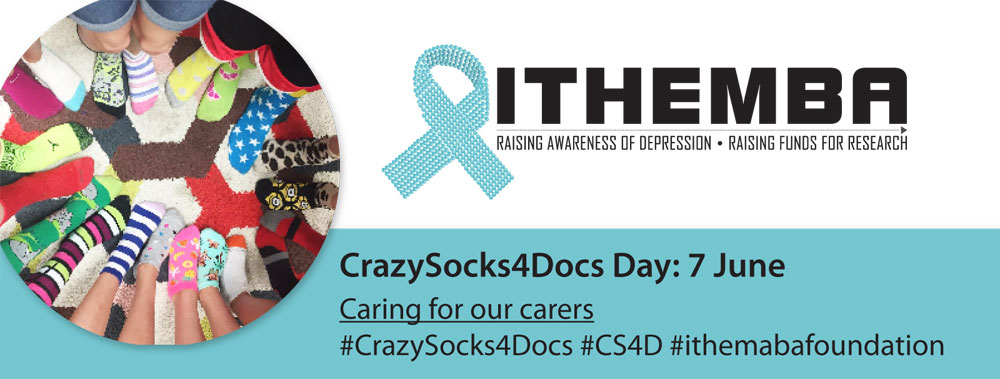
Start the conversation about the mental health of the medical profession and medical students by wearing your colourful, mismatched socks on #CrazySocks4Docs Day on Friday, 7 June.
It is critical that we highlight mental health in the health professions – especially amongst the next generation of medical professionals – as the stigma surrounding mental illness in doctors persists. Wearing mismatched, brightly-coloured socks may seem like a weird place to begin, but to care for others, we have to first care for ourselves and each other! Wear your “crazy” mismatched pair of socks on 7 June to show your support! Medical campuses will shortly be receiving their pro rata number of socks to be collected by medical students on a first come first served basis thanks to a partnership between the Ithemba Foundation and sock manufac- turer Falke as well as pharmaceutical company Cipla.
Medical students will also stand a chance to win cash prizes of R1 000 sponsored by the Ithemba Foundation, a non-profit that has two public benefit goals: to educate the public around mental health, specifically depression and related diseases such as anxiety disorders, and to support research.
Ithemba has launched the CS4D day to help break the silence around mental health among the medical profes- sion. Falke has sponsored 10 000 pairs of socks to be distributed on a pro rata basis on our medical campuses. PLUS: on each campus the student with the most likes for her/his “sock selfie” will win R1 000 cash! You only need to post your “sock selfie” on Ithemba’s FB using #ithembafoundation/#CrazySocks4Docs/#CS4D hashtag on June 7. You will automatically be entered into the draw to win that lovely cash prize of R1 000 on your campus – so start inspiring Mom, Dad, uncles, aunts, cousins, friends, the whole caboodle, to remember to go to Ithemba’s FB page on 7 June and “like” your sock selfie so that YOU can win that R1 000 cash!
The purpose of CS4D Day is to create awareness about:
Details of where and when you can collect your socks on a first come first served basis will follow shortly. And then wear your fun and funky socks on 7 June, post your sock selfies, and break the silence and the stigma!

Holiday time and the festive season may seem like, and should be, the most wonderful time of the year, and for many it is. Relaxing, resting, connecting with family and friends should be a positive experience and something to look forward to.
However, for some, it is a stressful, depressing and lonely time. For those dealing with relationship issues like divorce, personal grief, loneliness, economic concerns, or illnesses, this period can be extremely taxing. Add to this unrealistic expectations and the commercialization of Christmas and we may well find that we just wish to get the holiday over and done with. Also, for those with depression this may be a particularly difficult time and symptoms may exacerbate especially if there is pressure to attend family gatherings that they do not feel up to.
Tips to help you cope:
Stress, anxiety, and depression are common and may worsen during the festive season. Reach out, increase contact with positive understanding people. Try to avoid situations that may result in negative feelings. Make a greater effort over this period to connect with a family member that may be going through a hard time.